Compare
Side-by-side comparisons
Start with the short summary, then open a comparison to inspect each tradition's view and the sources behind it.
In plain words: Each page takes one question, like "How does each book remember Abraham's call?", and shows what each tradition says, side by side, with where it comes from.
Show me
17 results
Taken to Heaven Without Dying — Enoch, Elijah, and Beyond
The idea that certain righteous individuals were taken directly to heaven without experiencing death is shared across all three Abrahamic traditions, but the figures involved, the theological significance, and the literary traditions that developed around them differ enormously. The Torah's account of Enoch is a single cryptic verse (Gen 5:24), yet it generated one of the richest bodies of apocalyptic literature in antiquity — the Books of Enoch (1 Enoch, 2 Enoch, 3 Enoch), which describe heavenly tours, angelic hierarchies, and cosmic secrets. In some Jewish mystical traditions, Enoch is transformed into the archangel Metatron. The New Testament treats Enoch as a model of faith (Hebrews 11:5) and Jude quotes from 1 Enoch as prophecy. Islam identifies Enoch with the prophet Idris, who was "raised to a lofty station" (Quran 19:57) and encountered by Muhammad in the fourth heaven. The parallel with Elijah (taken by a chariot of fire) and Jesus (the Ascension) makes heavenly translation a recurring pattern in Abrahamic thought — though each tradition limits which figures qualify.
Noah's Flood — Covenant, Baptism, or Judgment?
All three traditions affirm the story of Noah and the great flood — a righteous man, a divine judgment, an ark, and a new beginning for humanity. But the theological weight each places on the narrative differs sharply. Judaism emphasises the Noahide covenant (7 universal commandments) established after the flood — the rainbow as sign of God's faithfulness to all humanity, not just Israel. Christianity reads the flood as prefiguring baptism — as Noah was "saved through water," so believers are saved through the waters of baptism. Islam focuses on Noah's prophetic mission — 950 years of preaching, the refusal of his people, and the flood as divine punishment; the drowning of Noah's own son despite his father's plea is a lesson about faith over kinship.
Elijah's Return — A Prophecy Applied Three Ways
Malachi 4:5 — "I will send you Elijah the prophet before the great and dreadful day of the LORD" — is applied differently by each tradition. Judaism takes it literally: Elijah himself will return before the Messiah, announced at every Passover Seder with a cup set for him at the table. Christianity reads it as fulfilled by John the Baptist, who came "in the spirit and power of Elijah" (Luke 1:17) as the forerunner of Jesus. Islam honors Elijah (Ilyas) as a true prophet but does not develop a theology of Elijah's return; the return of Isa (Jesus) at the end of days partially parallels the Elijah role. The prophecy illustrates how the same verse generates radically different theological constructions.
The Virgin Birth — Miracle or Metaphor?
Isaiah 7:14 is one of the most debated prophecies in the Hebrew Bible. The Hebrew word "almah" simply means "young woman" — the Septuagint (Greek OT) translated it as "parthenos" (virgin), and this translation is the basis for Matthew's claim that the virgin birth fulfills Isaiah's prophecy. Judaism reads Isaiah 7:14 as a prophecy for Ahaz's time — not a virgin birth, and not about a future Messiah. The Quran accepts the miraculous virgin birth of Jesus as historical fact — one of the clear signs (ayat) of God — but does not connect it to Isaiah's prophecy. The birth of Jesus from a virgin is simultaneously accepted by Islam, denied as Isaiah's prophecy by Judaism, and the specific term's meaning is disputed between Judaism and Christianity.
Circumcision — Eternal Sign or Superseded Ritual?
Circumcision was given to Abraham as the physical sign of the covenant — an outward mark of belonging to God's people. Judaism has maintained it as a binding covenant obligation for 4,000 years; brit milah on the 8th day is the most universally observed Jewish ritual. Islam practices circumcision as obligatory sunnah of Ibrahim, universal among Muslim men. Christianity, through Paul's decisive intervention at the Jerusalem Council (Galatians 2; Acts 15), declared that circumcision is not required for Gentile Christians and that the "circumcision that counts" is of the heart — the New Covenant replaces the physical sign with baptism. This is one of the clearest examples of Christianity breaking from its Jewish roots.
Women in Religious Leadership — Authority, Ordination & Law
The question of women's authority in religious leadership is one of the most actively debated topics within all three Abrahamic traditions today. Judaism moved from full exclusion of women in Orthodox tradition to full equality in Reform (1972) and Conservative (1985) movements. Christianity is divided: Catholic and Orthodox churches prohibit women's ordination, while most Protestant denominations ordain women — with the debate centering on two Pauline texts (1 Tim 2:12 vs. Gal 3:28). Islam classically restricts female leadership of mixed congregations in prayer and prohibits women from certain testimonial roles, though contemporary scholars debate these limits. All three traditions contain both restrictive and egalitarian impulses.
Salvation — Faith, Works, or Submission?
How is a human being saved, redeemed, or brought into right relationship with God? The three traditions give fundamentally different answers. Paul's landmark declaration "a person is justified by faith apart from works of the law" is central to Protestant Christianity and remains a point of debate with Catholic and Orthodox Christianity, both of whom emphasize cooperation with grace. Judaism does not use "salvation" in the Christian sense — the question is how to live rightly according to Torah and seek God's forgiveness through repentance. Islam teaches that salvation comes through faith (iman), submission (islam), and excellence (ihsan) — but it is ultimately God's mercy (rahma) that saves, since no human's deeds are sufficient without it.
The Future Prophet — Moses's Prophecy Applied
Deuteronomy 18:15 — Moses's promise that God will raise up a prophet "like me" from among the Israelites — is one of the most contested messianic proof texts in all Abrahamic scripture. Each tradition applies it to a different figure. Christianity sees it as fulfilled in Jesus, who is the new Moses — bringing a new covenant as Moses brought the old one, and confirmed by Peter's sermon in Acts 3. Islam identifies the prophecy as pointing to Muhammad — who brought a new law, led a community, and came from the Abrahamic family. Judaism reads it as a general promise that God will always provide legitimate prophets for Israel, not a single messianic prediction.
The Red Heifer — Purification and Its Limits
The red heifer (parah adumah) in Numbers 19 is one of the most enigmatic laws in the Torah — a "statute" (chok) whose reason is not given. A perfect red cow is burned outside the camp; its ashes mixed with water create a purification agent that cleanses those defiled by contact with a corpse, yet paradoxically renders the one who prepares it ritually impure. The rabbis called it the archetype of all inexplicable divine commands. Christianity reads it as a foreshadowing of Christ's atoning sacrifice — the perfect unblemished offering outside the city gates that cleanses from "dead works." Islam has a related but distinct "sacred cow" narrative in Surah Al-Baqarah: Moses commands the Israelites to slaughter a cow, which they question repeatedly, and whose flesh is used to miraculously reveal a murderer.
The Temple — Where Does God Dwell?
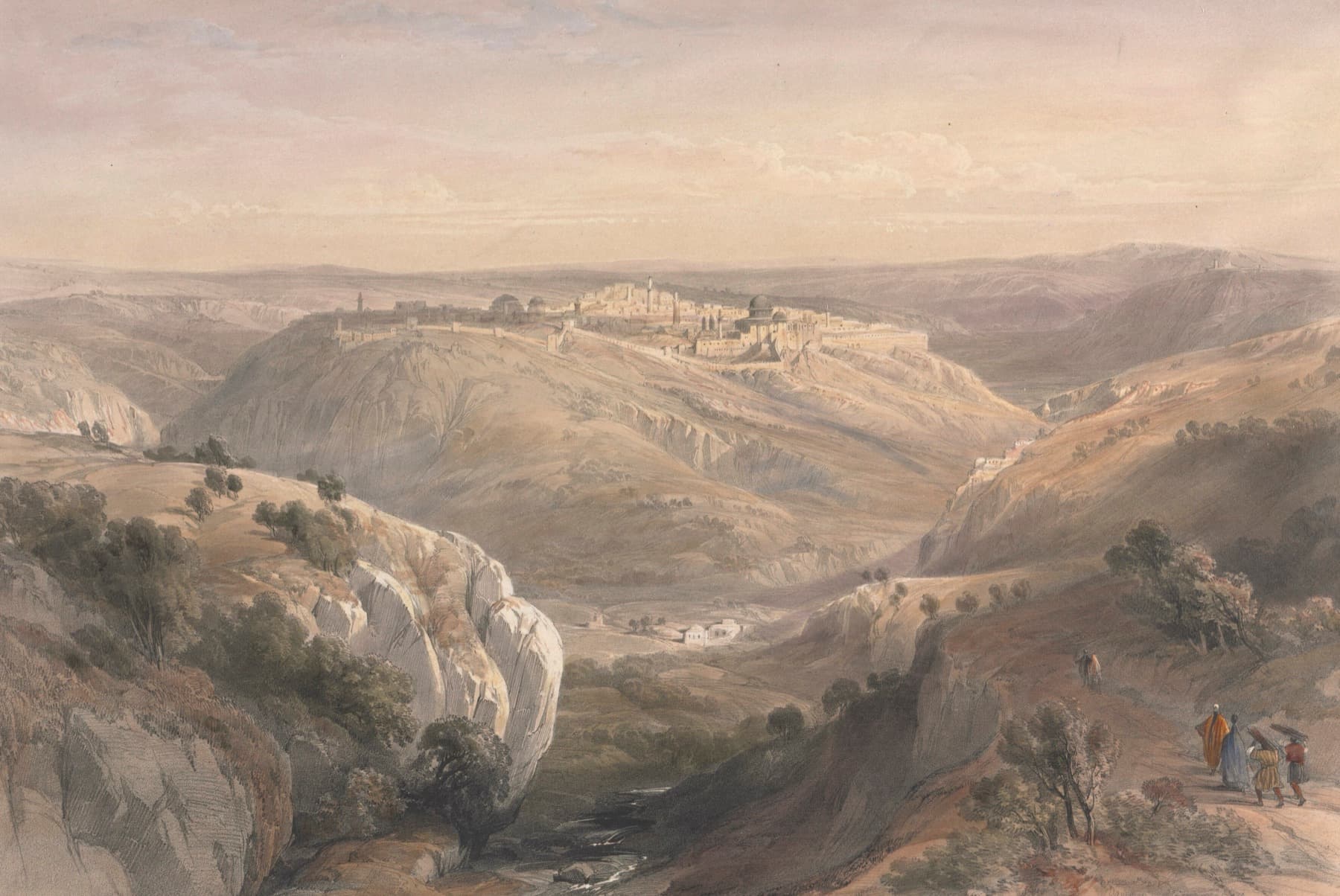
All three traditions trace their connection to the Temple in Jerusalem — the most physically contested religious site on earth. Judaism considers it the place God chose for His name to dwell; the Western Wall is all that remains after the Roman destruction of 70 CE, and the Temple's rebuilding is central to Jewish messianic expectation. Christianity teaches that Jesus replaced the Temple: his body, then the community of believers (the church), became the new sanctuary of God's presence — the stone Temple's destruction was theological completion, not tragedy. Islam reveres the Temple Mount (Masjid al-Aqsa) as the third holiest site in Islam — from which Muhammad ascended on the Night Journey — and has maintained a mosque there since the 7th century.
The Messiah — Who and What?
All three traditions use the word Messiah (Hebrew: Mashiach; Greek: Christos; Arabic: Al-Masih) — but they mean radically different things by it. Judaism awaits a human king from the line of David who will rebuild the Temple, gather the exiles, and usher in universal peace — criteria Jesus did not fulfill. Christianity teaches that Jesus is the Messiah who fulfilled the prophetic scriptures spiritually and will complete the remaining prophecies at his Second Coming. Islam affirms Jesus as al-Masih — a title of honour — but denies his divinity; a different messianic figure (the Mahdi) is awaited in Islamic eschatology. All three traditions expect a messianic resolution to history; none agree on who it is.
Dietary Laws: What Is Permitted to Eat?
All three traditions regulate what their followers may eat, but the scope and theological rationale diverge sharply. The Torah lays out detailed kashrut laws: clean animals must have split hooves and chew cud; seafood must have fins and scales; birds of prey are forbidden. Christianity, beginning with a vision recorded in Acts and reinforced by Paul, moved away from these regulations — Jewish dietary laws are not binding on Gentile Christians. Islam maintains a simpler set of restrictions (halal/haram): prohibiting pork, blood, carrion, and animals not slaughtered in God's name — closely mirroring the Torah's minimum prohibitions while not requiring the full kashrut system.
Fasting: Affliction, Devotion, and Self-Restraint
Fasting is a commanded practice in all three traditions, but its timing, purpose, and communal role differ substantially. Judaism observes Yom Kippur (the Day of Atonement) as the most solemn fast of the year — a full day of abstinence commanded in the Torah. Christianity does not mandate specific fast days in its scriptures; Jesus assumes his followers will fast privately and freely. Islam prescribes the entire month of Ramadan as an obligatory fast from dawn to sunset, with the explicit rationale of developing taqwa (God-consciousness). All three traditions agree that fasting is a form of worship; they disagree on when, how long, and for whom it is mandatory.
The Sabbath and the Day of Rest
All three traditions institutionalize a sacred time for communal worship and rest, but they do not agree on when, how, or why. Judaism observes the Sabbath from Friday sunset to Saturday nightfall as a perpetual sign of the Sinai covenant — the holiest day on the Jewish calendar. Christianity shifted the day of worship to Sunday (the Lord's Day), commemorating the Resurrection; Jesus himself taught that human need takes precedence over Sabbath regulations. Islam does not observe a Sabbath but gathers for Friday Jumu'ah prayer — a congregational obligation replacing the Sabbath's communal character without prohibiting work.
The Ten Commandments and the Moral Law
All three traditions acknowledge that God revealed a foundational moral code to Moses on Mount Sinai. The Torah preserves all Ten Commandments as eternally binding on Israel. Jesus distills them into two love commandments, declaring that all of Torah depends on these. The Quran, in Surah Al-Isra, presents a moral summary strikingly similar to the Decalogue — worship God alone, honour parents, do not kill — though not enumerated as "ten." Each tradition affirms the divine origin of this moral core, while differing on its scope, abrogation, and application.
The Annunciation: Mary's Conception of Jesus
Both the New Testament and the Qur'an describe an angelic announcement to Mary concerning the miraculous conception of Jesus. Both affirm the virgin birth. The New Testament identifies the angel as Gabriel and describes the conception as the work of the Holy Spirit, with Jesus declared the Son of God. The Qur'an describes the angel as a divine messenger (identified by commentators as Jibril), announces the birth of a pure son (Isa), and emphasizes his status as a prophet and Word of God — without affirming divine sonship.
The Oneness of God (Monotheism)
All three traditions are strictly monotheistic. The Torah's Shema (Deuteronomy 6:4) is the foundational declaration of God's oneness in Judaism. Surah Al-Ikhlas is the Qur'an's clearest statement of divine unity (tawhid), which explicitly states God neither begets nor is begotten — a formulation that many Islamic scholars read as a direct counter to Trinitarian Christianity. The Gospel of John's identification of the Word with God presents the most complex monotheism: one that Christian theology would later articulate as the Trinity. These traditions share absolute monotheism as a core commitment but disagree on what that oneness entails.